


How Kenya’s Stock Market Is Going Mobile: Your M-Pesa Could Be Your Stockbroker
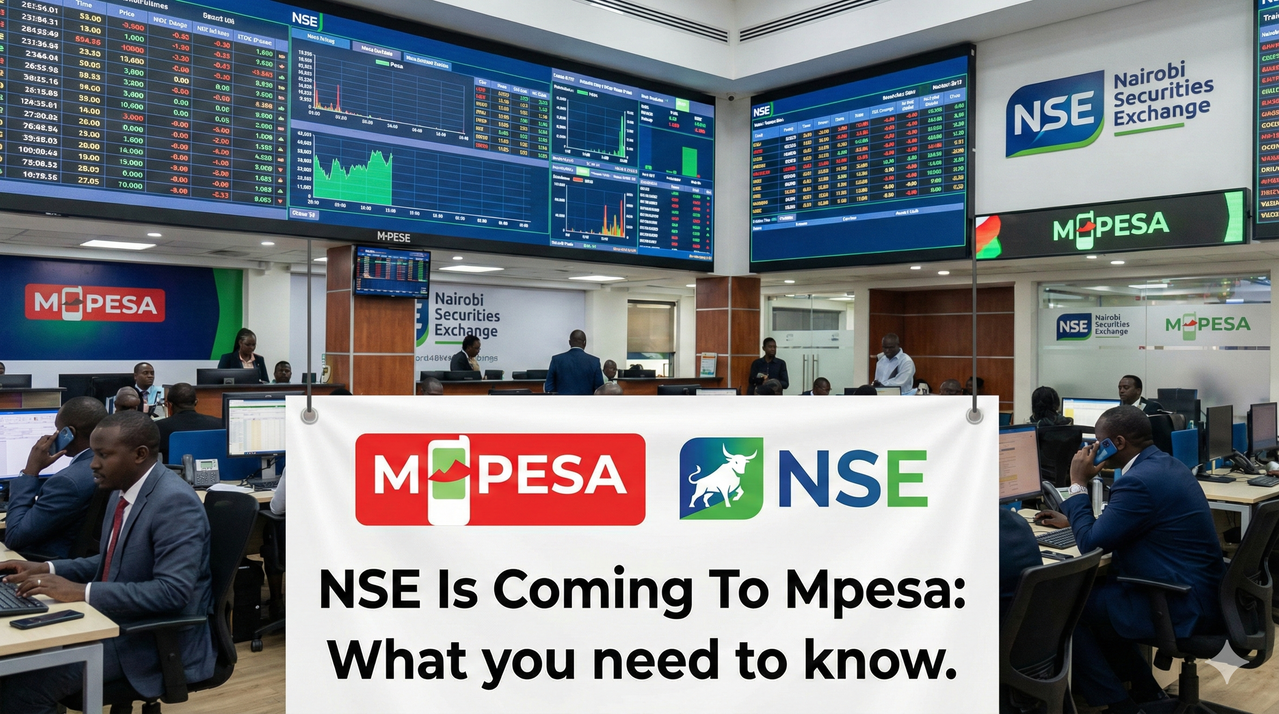
You know how sometimes you look at your phone and think, “Man, I wish I could just invest in something real—without jumping through hoops?” Well, starting January 2026, that dream is about to come true for millions of Kenyans. The Nairobi Securities Exchange (NSE) is rolling out a new feature called Ziidi Trader, which will let you buy and sell shares right from your M-Pesa app—no stockbroker, no paperwork, no stress.
Imagine this: you’re scrolling through your M-Pesa menu, and instead of just sending money or paying bills, you can tap “Invest” and buy shares in Safaricom, KCB, or any other listed company. No need to open a separate brokerage account. No minimum deposit requirements. Just your phone, your M-Pesa wallet, and a few taps. That’s it. The whole process is seamless—deposit, trade, withdraw, all from the app you already use every day.
But I know what you’re thinking: “Okay, but what is a ‘share’? How do I actually make money from this? What if I lose everything?”
Let’s break it down like we’re talking to a friend who’s never touched the stock market before.
What Is a Share? (The Cake Analogy)
A share is a small piece of ownership in a company.
Think of a company like Safaricom as a big cake.
- The company cuts that cake into millions of slices.
- Each slice is a share.
- When you buy 10 shares, you own 10 slices of that cake.
If the company does well (more customers, more profit), the cake becomes more valuable. So each slice (share) becomes more expensive.
If the company does badly, the cake loses value, and each slice becomes cheaper.
So trading is really just:
- Buy a slice when it’s cheap.
- Sell it later when it’s more expensive.
- The difference is your profit (or loss).
Simple Example: Buying and Selling Shares
Let’s use real numbers so it’s clear.
1. Buying Shares
Imagine today, Safaricom shares are selling at Kshs 20 per share.
You decide:
- “I’ll use Kshs 2,000 to buy shares.”
- How many shares can you buy?
Simple math (written out in words so it renders cleanly):
Number of shares = Money you have ÷ Price per share
= 2,000 ÷ 20
= 100 shares
So with Kshs 2,000, you now own 100 shares of Safaricom.
2. Selling Shares Later
A few weeks later, Safaricom’s business is doing well. The price of each share goes up to Kshs 25.
You decide to sell your 100 shares.
Money from selling = Number of shares × New price
= 100 × 25
= Kshs 2,500
You started with Kshs 2,000.
You end up with Kshs 2,500.
So your profit is:
Profit = 2,500 − 2,000 = Kshs 500
You just made Kshs 500 by buying low and selling high.
What If the Price Goes Down?
Now, let’s be real. It doesn’t always go up.
Same example:
- You buy 100 shares at Kshs 20 each → total Kshs 2,000.
- Later, the price drops to Kshs 18 per share.
If you sell now:
Money from selling = 100 × 18 = Kshs 1,800
You started with Kshs 2,000 and now have Kshs 1,800.
Loss = 2,000 − 1,800 = Kshs 200
So yes, you can lose money. That’s why people say: “Never trade with money you can’t afford to lose.”
But here’s the key:
- If you believe in the company, you can wait.
- If the price goes back up to Kshs 25, you’re back in profit.
- If it keeps falling, you can choose to cut your loss and move on.
How This Works on M-Pesa (Ziidi Trader)
From January 2026, you’ll be able to do all of this directly from your M-Pesa app.
Here’s how it will feel:
- Open M-Pesa and tap the “Invest” or “Ziidi Trader” option.
- Choose a company (e.g., Safaricom, KCB, Equity).
- See the current price per share (for example, Kshs 20).
- Enter how much money you want to use (e.g., Kshs 2,000).
- Confirm the trade—your shares are bought and appear in your portfolio.
- Later, when the price goes up, you tap Sell, and the money goes straight back into your M-Pesa balance.
No broker. No forms. No Kshs 100,000 minimums.
Just your phone, your cash, and a few taps.
Real-Life Possibilities (Not Promises)
Let’s look at what this could mean for a normal person.
Example 1: The Hustler Saving Kshs 1,000 a Month
- Every month, you save Kshs 1,000.
- Instead of leaving it idle in M-Pesa, you buy shares.
- Suppose the average price you buy at is Kshs 20 per share.
Each month:
Shares bought = 1,000 ÷ 20 = 50 shares
After 12 months:
- Total invested = Kshs 12,000
- Total shares = 50 × 12 = 600 shares
If the price rises to Kshs 25:
Value = 600 × 25 = Kshs 15,000
Profit = 15,000 − 12,000 = Kshs 3,000
If the price climbs to Kshs 30:
Value = 600 × 30 = Kshs 18,000
Profit = 18,000 − 12,000 = Kshs 6,000
Not lottery money—but slow, steady growth, like planting a tree and waiting for it to bear fruit.
Example 2: The Trader Who Buys Low, Sells High
Some people enjoy active trading.
- You see Safaricom fall to Kshs 18 after bad news.
- You think that’s temporary and buy 200 shares:
Cost = 200 × 18 = Kshs 3,600
A few weeks later, the price recovers to Kshs 22.
Sale value = 200 × 22 = Kshs 4,400
Profit = 4,400 − 3,600 = Kshs 800
Kshs 800 in a few weeks—just from watching the market and acting.
The Human Side: Fear, Greed, and Patience
What no one tells you:
- When the price jumps, you feel like a genius.
- When it drops, panic whispers, “Sell now before it gets worse.”
- When it moves slowly, boredom convinces you to chase something “more exciting.”
The people who survive and win are not necessarily the smartest or richest. They are the ones who:
- Never use rent, school fees, or emergency money to trade.
- Don’t expect to double their money in one week.
- Are patient enough to think in years, not hours.
What This Means for You
If you’ve ever thought:
- “I wish I could invest, but it’s too complicated.”
- “I don’t have enough to start.”
- “This stock market thing is only for rich people.”
Ziidi Trader is meant to blow up those excuses.
It won’t magically make you rich.
But it does finally give you:
- A low-barrier way to start (even with Kshs 500–1,000).
- A chance to learn by doing, not just by watching others.
- A tool you already understand—M-Pesa—turned into your entry ticket to the stock market.
Real financial freedom rarely starts with a jackpot.
It starts with small, consistent, smart decisions.
And for the first time, those decisions are going to live in the same place you buy airtime and send cash to your mum: right there in your M-Pesa menu.